Local Government Reform: Turning Statutory Change into Sustainable Progress
Local government reorganisation — bringing district and county councils into a new unitary authority — is a transformation programme, not only a technical cutover. Vision ERP advises on ERP options and supports wider planning so finance, HR and payroll stay safe and legal on vesting day, while a clear path of improvements follows at a sustainable pace.
There is a path to vesting day. Do not leave planning until members have been elected — that creates a rush. Get discovery, options appraisal and governance under way earlier, so Day-1 is controlled and the backlog is deliberate.
Vision ERP supports UK Local Government Reorganisation programmes, including live programme delivery — from discovery and options appraisal through Day-1 continuity and stabilisation.
Book a Strategic Reform Consultation



Why Reform Is an Opportunity for Structural Improvement
Local government reorganisation brings district and county councils — with their contracts, systems and operating models — into a new unitary authority. Without structure, the risk is duplication, inconsistent governance and a fragmented technology estate.
The opportunity is to treat reform as transformation: standardise core processes, strengthen financial and operational controls, and simplify systems around an agreed target operating model — not only to survive Day-1.
Vision ERP begins with structured discovery and process review, mapping current operations, identifying control gaps and defining a target operating baseline. That sets a delivery plan which protects Day-1 continuity and creates a controlled pathway for modernisation beyond vesting day.
Our Reform Delivery Approach
Vision ERP supports Local Government Reorganisation through a structured, governance-led delivery model. It protects statutory services on vesting day, supports ERP options advice and wider transformation planning, and enables harmonisation at a sustainable pace.
Structured Discovery & Target Operating Design
We begin with focused discovery: map existing processes across merging organisations, identify duplication, and define a harmonised target operating model aligned to statutory, financial and service delivery requirements — before the pressure of an election timetable sets in.
Compliance by Design
Financial controls, audit frameworks, and governance structures are embedded from the outset to safeguard transparency, accountability, and regulatory compliance throughout organisational change.
Collaborative, Vendor-Aligned Delivery
Reform programmes involve multiple stakeholders and suppliers. We coordinate closely with your existing partners to ensure continuity, reduce duplication, and maintain alignment across systems and service contracts.
Specialist ERP and Platform Harmonisation
Where ERP platforms and related systems support consolidation and modernisation, we provide deep configuration, migration and integration expertise aligned to public sector best practice and controlled system transition.


From Mobilisation to Improvement: Your Path to Vesting Day
A structured reform sequence aligned to your statutory timetable and organisational scope — from mobilisation through vesting day and into stabilisation. The objective is a controlled Day-1 transition for the new unitary authority, with a defined backlog of improvements delivered afterwards at a sustainable pace. Start this sequence early; do not leave it until members are elected.
Mobilise
Establish programme governance, Senior Responsible Owner (SRO) accountability, risk controls, and a validated technical baseline to create a stable foundation for reform delivery.
Discover & Process Review
Conduct structured process mapping to assess current operations, identify duplication, define control requirements, and agree a harmonised target operating baseline.
Platform & Integration Blueprint
Undertake options appraisal (retain, adopt, consolidate, or integrate), define API contracts, assess security posture, and design a resilient integration architecture aligned to reform objectives.
Data: Scope & Governance
Define master data ownership, quality controls, retention policies, and DPIA requirements to ensure compliant and controlled data migration.
Build & Migrate (Iterative)
Deliver migration and integration in controlled cycles, validating data integrity and system performance through structured testing and rehearsal.
Assure & Train
Embed segregation of duties, audit trails, and role-based access controls while delivering structured, role-specific training to support confident adoption.
Cutover Rehearsal & Day-1
Execute structured dry runs, communication planning, and support model validation to protect statutory services at transition.
Stabilise & Optimise
Provide post-go-live governance, defect resolution, and continuous improvement planning to deliver long-term operational resilience.
What You Gain with Vision ERP
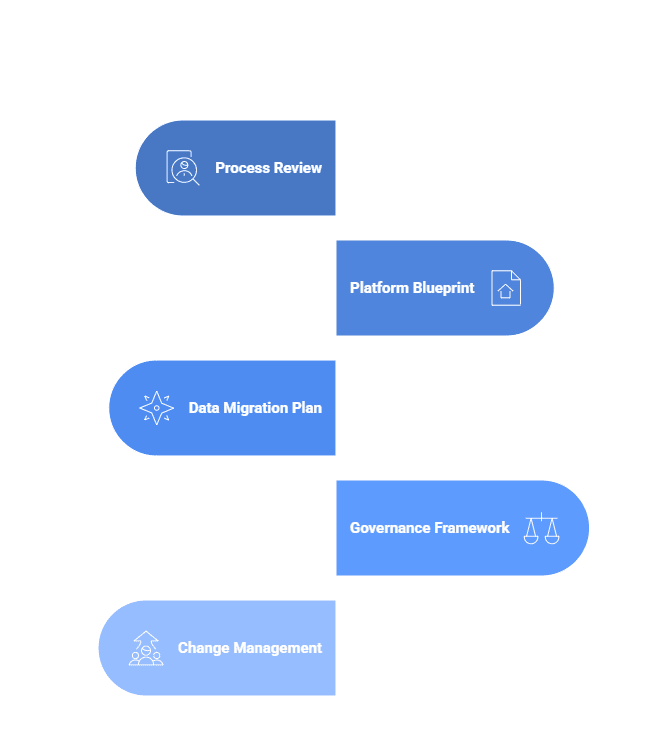
Structured Process Review & Target Operating Model
A comprehensive assessment of current processes leading to a harmonised target operating model aligned to statutory, financial, and service delivery requirements.
Platform & Integration Blueprint
A resilient platform design and integration architecture, aligned to security standards, governance frameworks, and long-term interoperability requirements.
Controlled Data Migration Plan
A structured data migration approach with defined ownership, quality controls, audit checkpoints, and regulatory compliance safeguards.
Governance & Assurance Framework
Defined programme checkpoints, documented decision logs, and auditable controls to maintain transparency and accountability throughout reform delivery.
Change Management & Role-Based Enablement
Structured communications, stakeholder engagement, and role-specific training materials to support confident adoption and sustained operational stability.

After Day-1: optional ongoing support
Day-1 protects statutory services. What comes next is a choice. Once the new organisation is live, some councils want a partner to keep their ERP and related applications stable while the improvement backlog is delivered at a sustainable pace.
Vision ERP can provide optional Managed Application Services after vesting day — structured support, governed change and continuous improvement for your applications estate. If you also need payroll run and checked as a bureau service, Managed Payroll Services are available as a further option.
Neither is required to work with us on your LGR programme. They are there if you want to go further once planning and Day-1 are under way.

Optional payroll aftercare
If you also need payroll run and checked as a bureau service after vesting day, Managed Payroll Services are available as a further option.

Frequently Asked Questions
Plain answers to the questions councils ask when ERP and related systems sit inside a Local Government Reorganisation programme.
What does Local Government Reorganisation mean for ERP and council systems?
LGR brings district and county (or other) councils into a new unitary authority, with shared systems, data and operating models. For finance, HR and payroll systems, that usually means an options appraisal — retain, adopt, consolidate or integrate — then a controlled programme that protects continuity on vesting day while a longer improvement backlog is planned.
What must work on Day-1, and what can wait?
Day-1 (vesting day) is about safe and legal continuity: payments, payroll, statutory reporting, identity and the controls that keep services running. Transformation beyond that — deeper harmonisation, optimisation and backlog items — should be sequenced after go-live at a sustainable pace, not left as an unplanned rush.
Should we retain, adopt, consolidate or integrate our ERP?
It depends on your target operating model, estate and risk. Some programmes retain a primary platform and bring others across; others adopt a county or shared-service instance, consolidate onto one primary ERP estate, or integrate for a period. Vision ERP runs a structured options appraisal so the choice is explicit before blueprint and migration begin.
How is data handled, including DPIAs?
Master data ownership, quality, retention and Data Protection Impact Assessment (DPIA) requirements are defined up front. Migration then runs in controlled cycles with checkpoints, so data moves with a clear owner and an auditable trail rather than as a single high-risk cutover.
Who supports the ERP and applications after go-live?
That is your choice. Vision ERP can provide optional Managed Application Services after vesting day — ongoing support and governed change for your applications — or you may keep support with an existing partner. Aftercare is not assumed; it is agreed only if you want it.
How is payroll handled when organisations merge?
Payroll and HR data are usually on the critical Day-1 path: people must be paid correctly from vesting day. Harmonising pay, establishments and processes often continues afterwards. If you want a bureau to check, process and file payroll once the organisation is live, Vision ERP’s Managed Payroll Services are an optional route — separate from the LGR programme itself.